
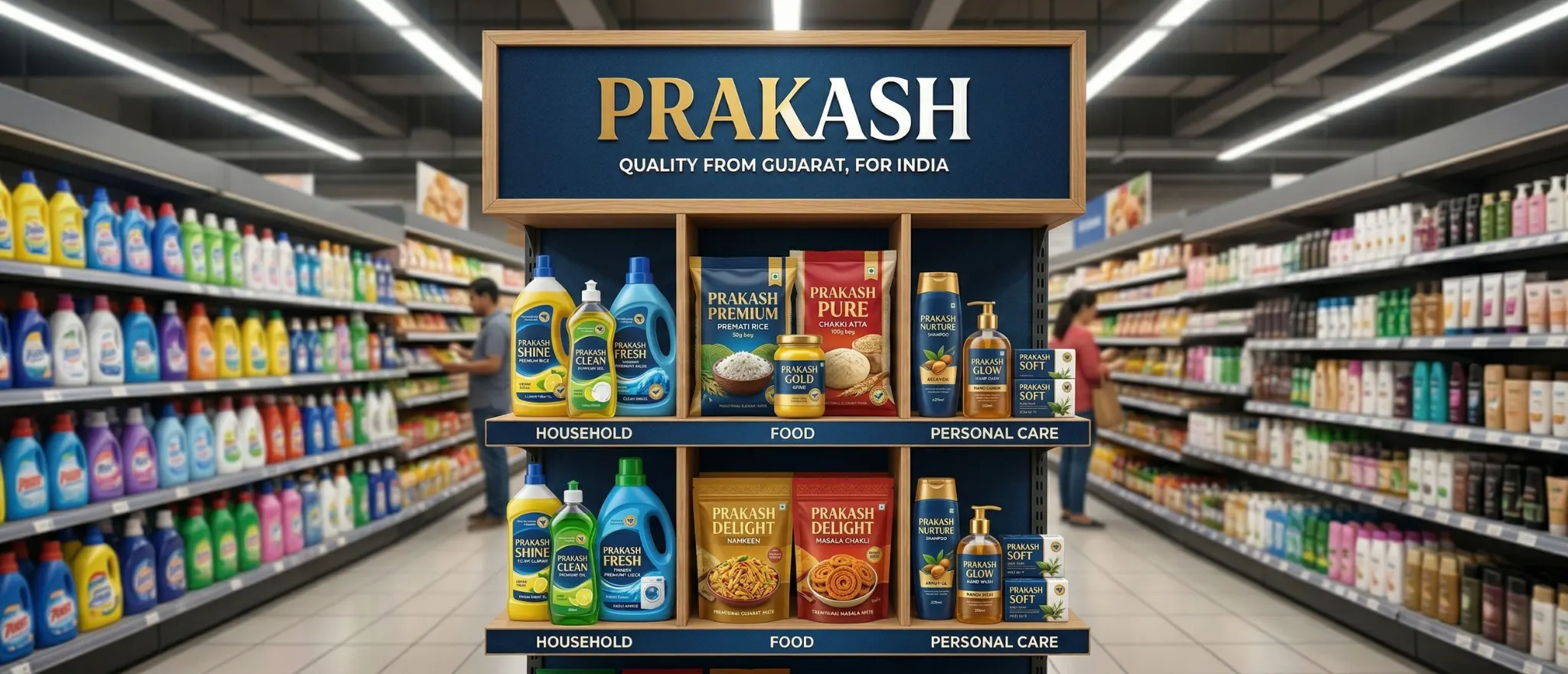
Building FMCG Brand Identity from Baroda: Why Gujarat’s Manufacturers Are India’s Next Big Brand Story
April 6, 2026Gujarat Makes the Products. But Gujarat Is Not Yet Making the Brands.
This is a statement that will challenge and perhaps provoke some readers from the FMCG business community in Baroda, Ahmedabad, and Surat. But it is said with deep respect and with the conviction that the gap it identifies represents the single biggest business opportunity available to Gujarat’s FMCG manufacturers right now.
Gujarat’s manufacturing infrastructure is extraordinary. The state produces a significant share of India’s FMCG products from food and beverage to personal care, from cleaning products to packaged goods. The production quality, the supply chain sophistication, and the entrepreneurial drive of Gujarat’s FMCG sector are world-class.
And yet, when we look at the brands that capture the premium value in these categories nationally the brands that command the highest prices, the best shelf placement, the strongest consumer loyalty a disproportionate share of the brand value is captured elsewhere. Gujarat manufactures but does not always brand. And brand is where the margin lives.
1. The Manufacturer to Brand Transition: What Changes and What Does Not
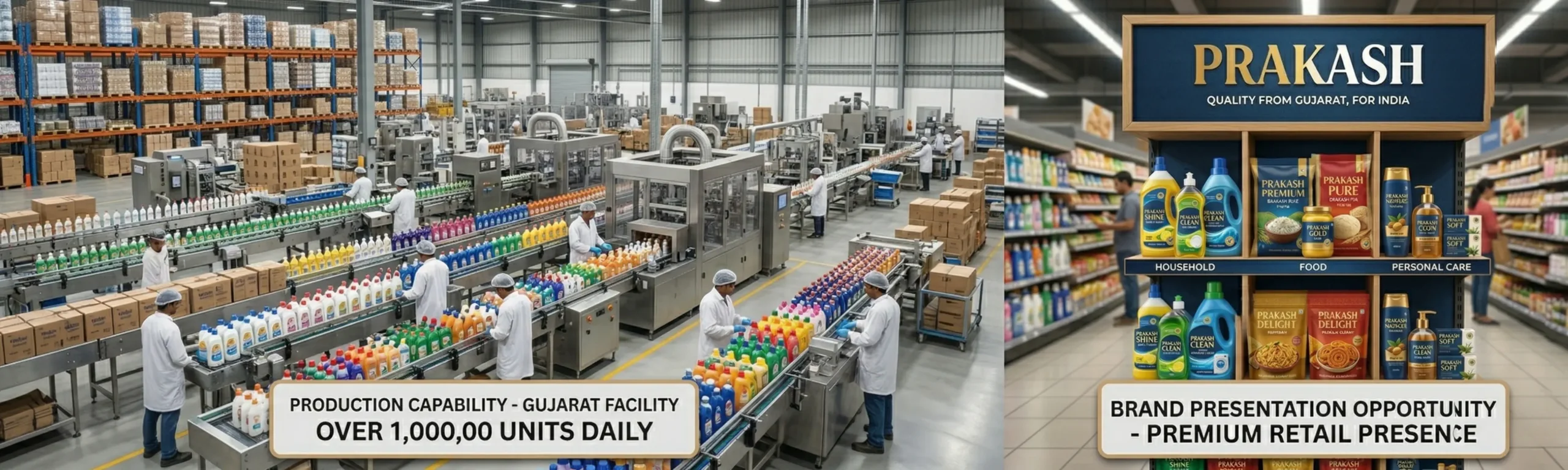
For Gujarat FMCG manufacturers considering the transition from B2B supply or private label production to building their own brand, the journey is significant but absolutely achievable. What must change is the investment mindset from optimising for production cost to investing in brand value creation. What does not change is the product quality advantage that Gujarat manufacturing already delivers.
The manufacturer-to-brand transition requires investment in:
- Brand strategy defining positioning, target audience, and market differentiation clearly
- Brand identity logo, visual system, packaging design built for brand, not just function
- Channel strategy understanding which retail and distribution channels match the brand positioning
- Marketing investment building brand awareness and trial with the right consumer segments
- Brand team capacity internal ownership of brand decisions rather than outsourcing everything
2. The Private Label Trap and How to Escape It
Many Baroda and Surat FMCG manufacturers have built substantial businesses through private label production making products for larger national brands who put their own packaging and branding on Gujarat made goods. This is a legitimate and often profitable business model, but it has a structural ceiling.
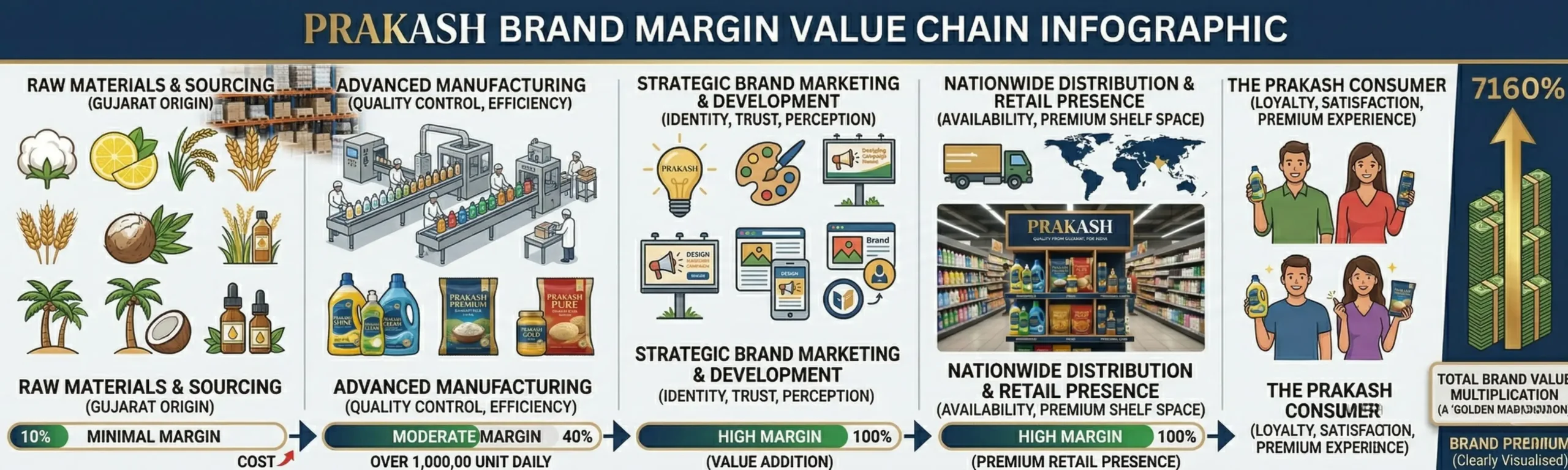
In private label production, the manufacturer captures production margin but surrenders brand margin and brand margin, over time, is where the most significant value accumulates. The brand owner who uses your production facility to supply their nationally known product is capturing margins that are multiples of yours, built on your manufacturing capability.
The manufacturers who break out of this ceiling are the ones who make the strategic decision to build their own brand often using the same formulations, the same production capability, but now investing in the brand asset that allows them to capture the full value chain.
3. FMCG Brand Architecture: Building a Portfolio That Scales
One of the most important strategic decisions a Gujarat FMCG manufacturer makes when building their brand is whether to build a mono-brand all products under one master brand or a house of brands separate brand identities for different product categories or consumer segments.
For most Gujarat FMCG manufacturers at the brand building stage, a mono brand strategy with strong sub brand architecture is the most capital efficient approach. One master brand, built with enough equity and meaning to stretch across multiple product lines, with clear variant and range architecture below it.
This requires getting the master brand strategy and identity right from the beginning because everything that comes later builds on that foundation. A weak or generic master brand identity limits how far the portfolio can stretch without the sub brands feeling disconnected and incoherent.
4. Distribution Channel and Brand Design Alignment
For Baroda-based FMCG brands targeting national distribution, the packaging design must work across dramatically different retail environments simultaneously from modern trade supermarkets in Mumbai and Bengaluru to general trade kirana stores in tier-2 cities to online marketplaces across India.
This multi channel requirement is one of the most technically challenging aspects of FMCG packaging design. What works at eye level in a Reliance Smart must also work on a kirana shelf where the shopkeeper stacks products without regard for brand hierarchy. What photographs beautifully for an Amazon listing must also be scannable in a distribution centre.
Multi-channel FMCG packaging design principles:
- Brand mark must be legible at every scale from shelf label to truck livery
- Colour blocking must differentiate the brand from channel-specific competitors
- Pack architecture must accommodate retailer-specific SKU requirements without losing brand coherence
- E-commerce packaging must be designed for the white background thumbnail test
5. The Gujarat Brand Advantage: Authenticity as a Brand Asset
For Gujarat made FMCG products in categories like food, spices, namkeen, traditional snacks, and Ayurvedic personal care, the Gujarat origin is a genuine brand asset if the brand identity is built to leverage it.
Consumers across India and internationally associate Gujarat with quality food production, business integrity, and authentic traditional recipes. A Gujarat origin FMCG brand that leads with this provenance authentically, not as a cliche is tapping into a reservoir of positive consumer association that competitors from other regions cannot replicate.
At Richest Branding, we have helped multiple Gujarat FMCG brands build this provenance narrative into their brand identity creating a visual and verbal brand language that is simultaneously premium and rooted, modern and authentic. The result is brands that do not just sell products they sell a story that belongs only to Gujarat.
6. The Investment Calculus: What FMCG Brand Building Costs and What It Returns
The most common question we receive from Gujarat FMCG manufacturers considering brand investment is a version of: how much does it cost, and what will I get back? It is a fair question, and one that deserves a direct answer.
The cost of building a complete FMCG brand identity strategy, logo, packaging system, brand guidelines, and launch collateral is an investment that begins delivering returns from day one of launch. Better retail placement, higher initial price point achievement, faster trial and repeat rates, and stronger distributor confidence are all measurable outcomes that typically deliver return multiples on brand investment within the first year of operation.
The most important thing to understand is this: the cost of not investing in brand is higher than the cost of investing in it. Every year that a Gujarat FMCG manufacturer operates without a premium brand identity is a year of capturing production margin while surrendering brand margin to competitors. That accumulated foregone value is the real cost of delay.
At Richest Branding, we build FMCG brands for manufacturers who are ready to stop just making great products and start owning great brands. Because the most powerful businesses in the world are not the ones that manufacture the best. They are the ones that brand the best. And Gujarat has every ingredient it needs to brand the best in the world.
Ready to Build a Brand That Builds Empires?
Strategy • Design • Impact
www.richestbranding.com | info@richestbranding.com
Richest Branding — Strategic Branding that Builds Empires

